To shorten the length of today’s motif I only wove a potion of it. But choosing what portion to weave…
There were so many possible ways to combine these two shapes. For example: the triangles pointing away from the diamond or diamonds on the outside of a triangle or two… I could easily get lost playing with design.
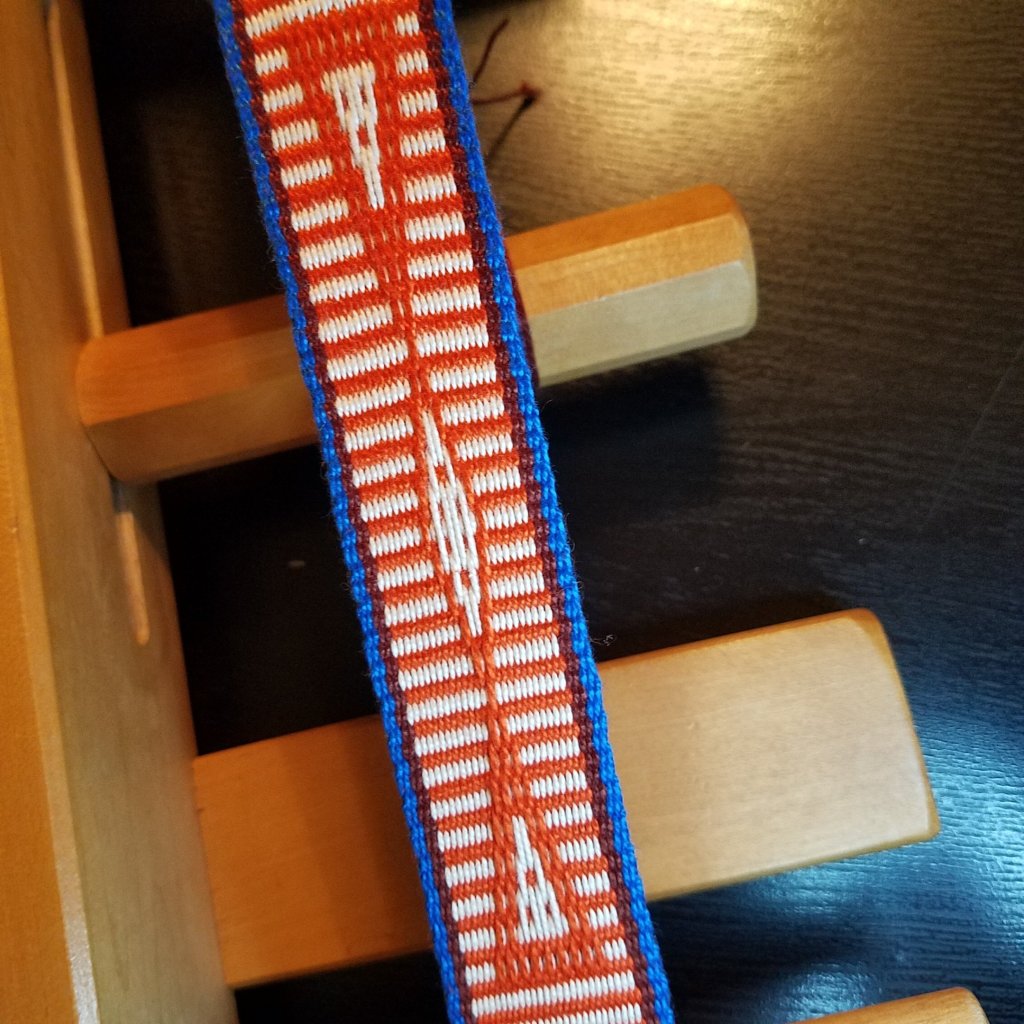
Today’s motif is a sweet little diamond, the key word being little. It is only nine warp ends wide and nine pick tall. I felt it needed a friend, so I wove one. The orange diamond is the original design from page 38 in Anne Dixon’s book, The Weaver’s Inkle Pattern Directory: 400 Warp-Face Weaves. It is woven mostly using the unheddled threads, all except the two warp ends in the middle. Mine is woven on the heddled threads.
In counting out my pickup threads today, I realized I warped 26 pattern threads instead of 25. Hopefully some upcoming designs will not look too askew with a random line of color in the band. We shall see. Saturday’s motif is intense in pickup and is 25 ends wide.
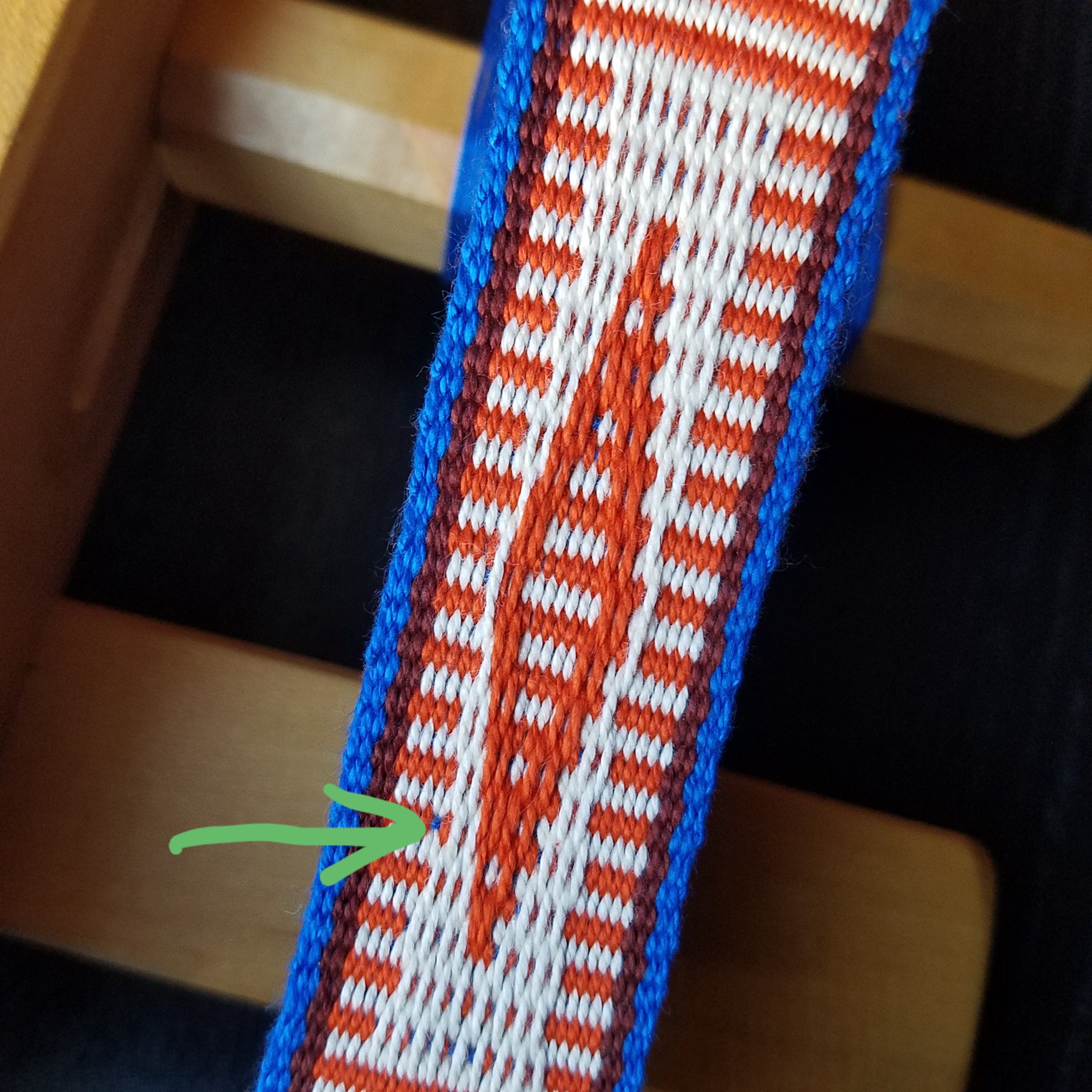
Did you spot the mistake in yesterday’s motif? Someone wrote wondering where it is. See the little blue dot of weft peeking through. There should be an orange warp end there. I didn’t drop it from the front and it acted as a picked up warp end. Oops. I am always in awe of people who do wonderfully intense pickup and don’t skip any threads.
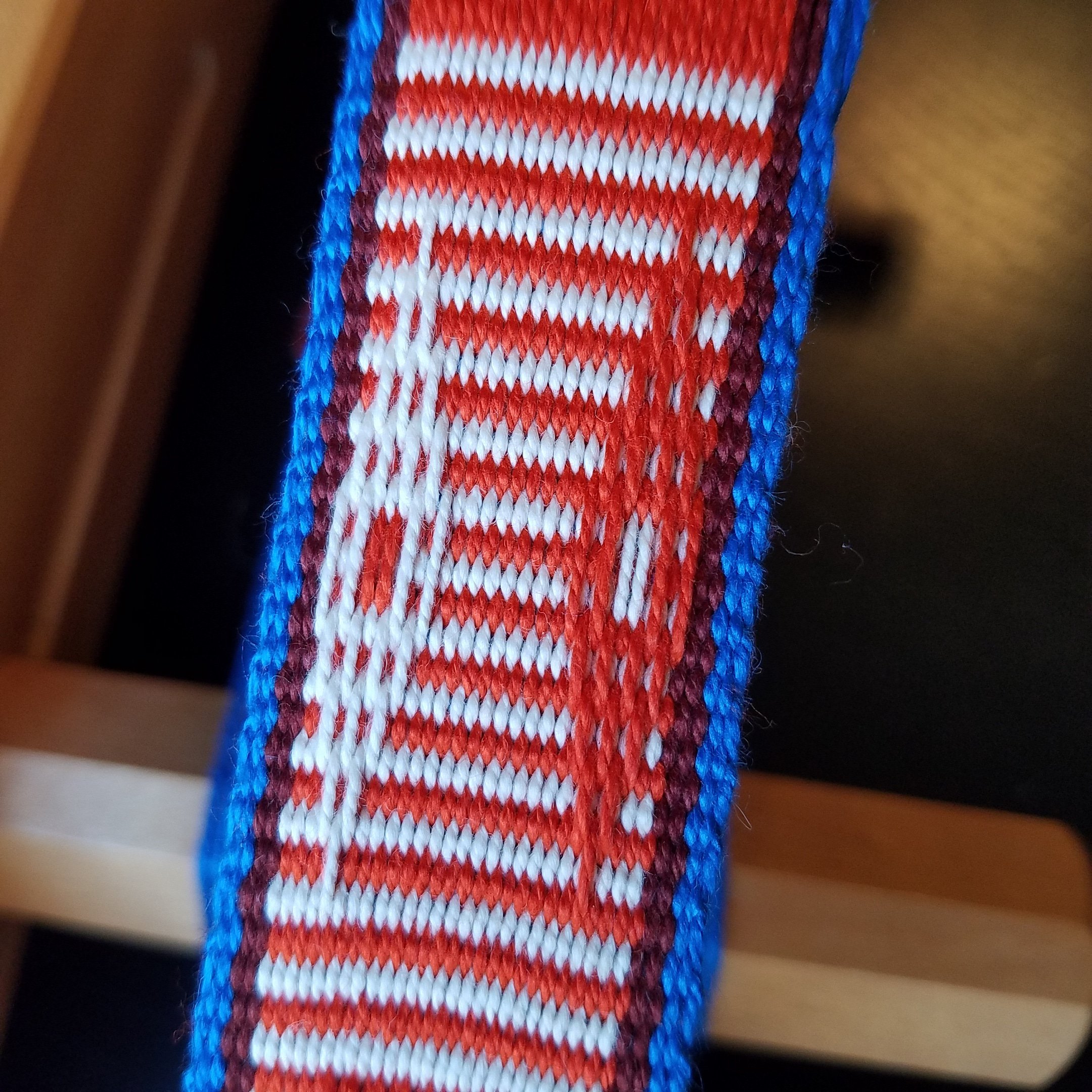
The technique of pickup with both heddled and unheddled warp threads makes it very difficult to maintain a consistent band width. (Ha, that’s a good pun.) When picking up many threads, the band will naturally want to draw-in. This happens even more the more threads picked up. One way to counter the draw-in is to drop the partner (heddled or unheddled) thread for every thread picked up. When the partner thread is dropped, the reverse of the motif will be on the other side.
The motif on the left is the original pattern from page 38 in The Weaver’s Inkle Pattern Directory: 400 Warp-Faced Weaves by Anne Dixon. The motif on the right is the band flipped over. And as I look at reverse side picture, I see a spot where I didn’t drop a thread. Oops. Weaving goes much faster when picking up only, and for simple patterns I usually only do pickup. This motif in the book only calls for pickup. But picking and dropping threads really makes a striking band. How do you usually do this type of pickup?
For the last week I have been pondering what the colors would be for the March daily band practice band. Orange was speaking to me as a color to work with, but I was at a loss for what the other colors would be. That is, until I found my inspiration picture on Saturday of the Namibian desert posted by Visages d’Afriques to their Facebook page.
I took a screenshot of the picture, printed it out and went to my Lunatic Fringe Yarns stash. Natural was perfect for the low brush, 5 Yellow Red for the rich orange clay, Burnt Umber for the mountains, and 10 Blue was the right blue for the sky.
I really like the combination. Why wouldn’t I, who am I to argue with nature? The brown doesn’t show the way I anticipated. I am tempted to add a bit more for it to stand out…
Inspiration comes without warning, and this was perfectly timed. This may be the first time I have used a picture as color inspiration. What inspires you in your weaving?
Motif from The Weaver’s Inkle Pattern Directory: 400 Warp-Faced Weaves by Anne Dixon, page 38.
Someone asked if I have learned anything so far in my daily band practice. At the time my answer was not yet, but what I would answer today is, if I get behind by one day of blogging, it is not as easy to catch up as I’d like. Time seems to melt away. But, isn’t that the point of why I am doing a daily band practice. If I do not commit to make time for weaving, I will definitely never find time. That being said, let’s get caught up.
Day 46
Day 47
Day 48
Day 46: Seems very similar to Day 44 to me, but with a more modern feel. Day 47: Do you see honeycomb? Day 48: I was ever so grateful to have my daily band practice on this day. It was stressful day and weaving this meandering chain was just the meditation I needed.
Day 49
Day 50
Day 51
Day 49: We have a lot of creepy crawly things here in Florida. Maybe I have lived here too long, but this motif reminds me of a few of them. Day 50: I made a mistake in this one and didn’t notice until I had taken the picture. Can you spot it? Day 51: I was excited to weave this S motif. In Baltic pick-up it is one of my favorites, so it was fun to weave an S in horizontal strip pick-up.
Day 52
Day 53
Day 54
Day 52: Pick-up on horizontal strips that mixes single and double warp threads creates such interesting motifs. Day 53: This motif creates the illusion of subtle curves by mixing single and double pick-up threads combined with mixing three and five pick floats. Day 54: This one almost didn’t make it into existence, I didn’t make time with intention, but just before bed I did it. It was the perfect way to end the day.
Day 55
Day 56
Day 57
Day 55: We have some beautiful flowers blooming right now, maybe that’s why this motif reminds me of flora and fauna. Day 56: This time, the mixing of single and double pick-up threads created a motif that resembled pulled thread embroidery. Day 57: Wow, did this motif weave differently than what I expected from the pattern in the book. Actually, I almost didn’t weave it because it look to be so similar to Day 49. There are slight bends, not sharp angles each time the ladder turns. Again, this was achieved by mixing single and double pick-up threads.
Day 58
Day 59
Day 58: More mixing of single and double pick-ups and mixing of three and five pick floats at play. Day 59: What a perfect way to close out the month, with an S motif. I am not sure why I like these so much, but I really do.
My loom is warped up and ready for March. All of these motifs are from The Weaver’s Inkle Pattern Directory: 400 Warp-Faced Weaves by Anne Dixon, pages 36-37. I will be weaving a few motifs from Mary Meigs Atwater’s Byways in Handweaving next month.
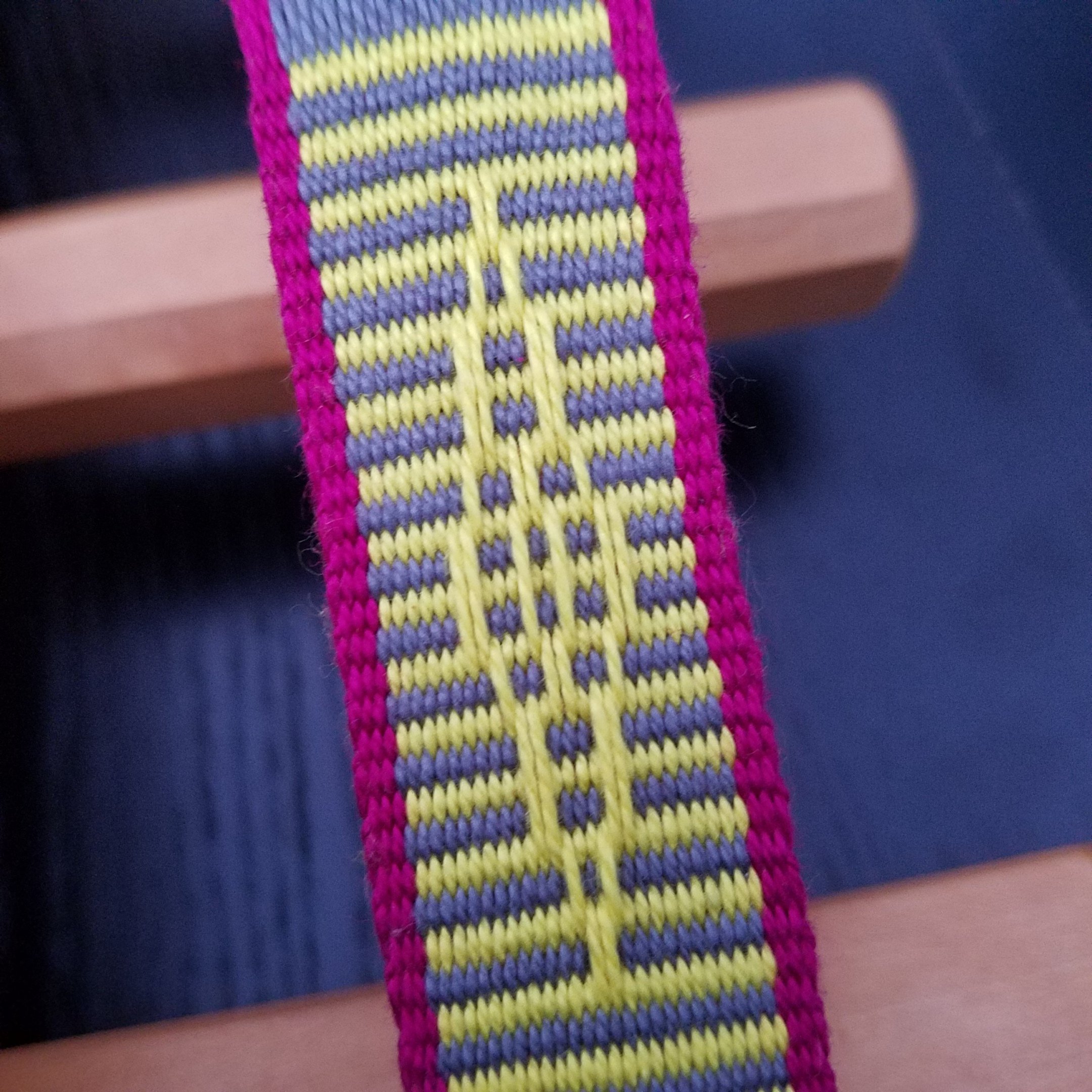
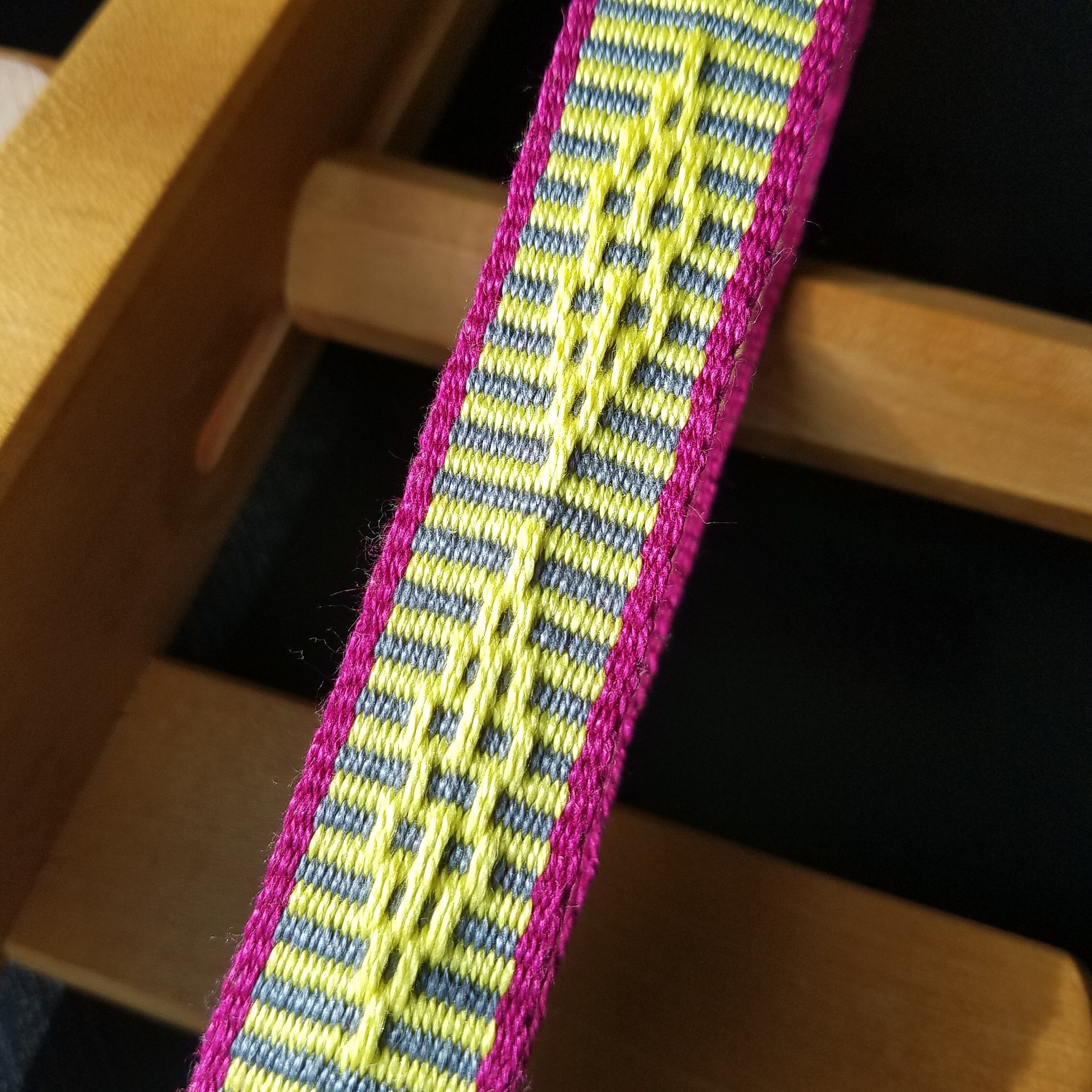
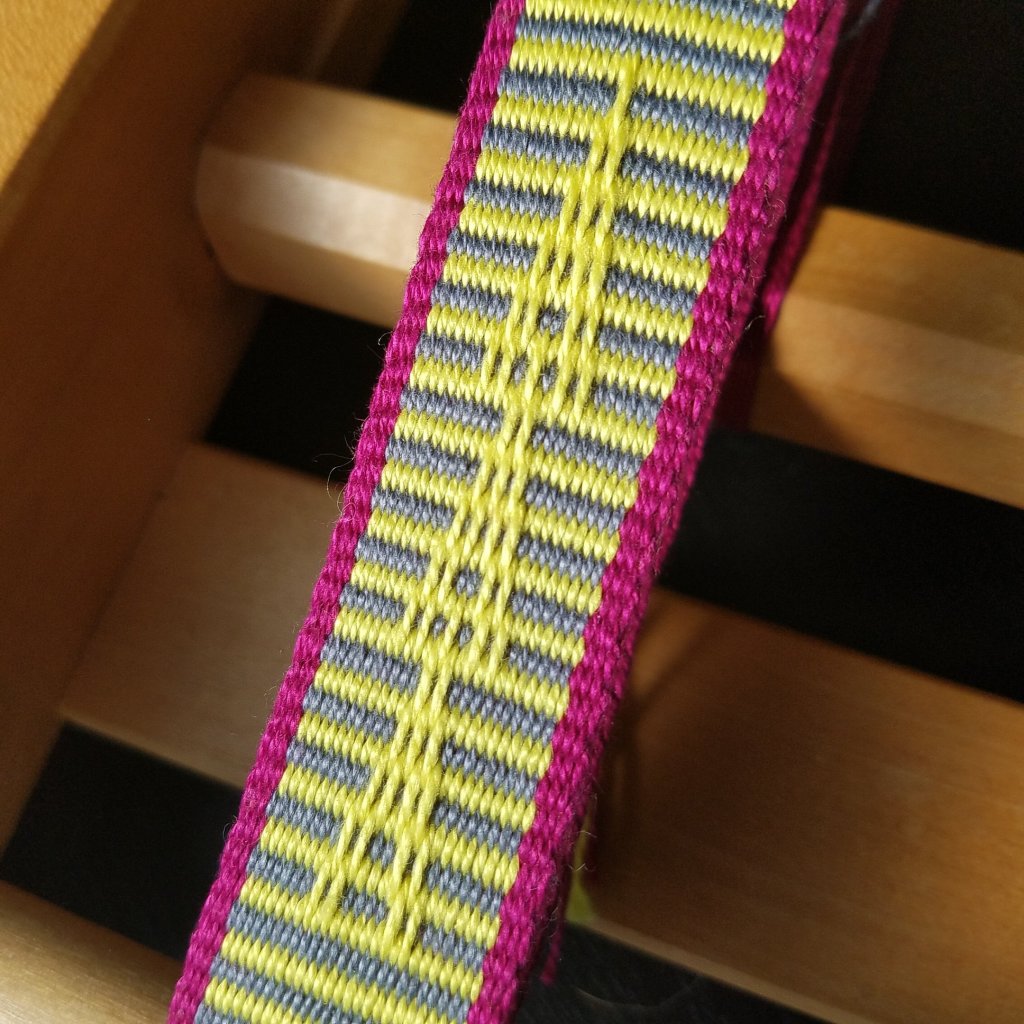
Today’s motif features warp ends picked up in pairs and a mixture of three pick and five pick floats. I was surprised by the final look of the motif. It reminds me a bit of filigree belt buckle I saw once. I’d like to see how it would look with the middle long float in a different color than the rest of the motif.
From The Weaver’s Inkle Pattern Directory: 400 Warp-Faced Weaves by Anne Dixon.
New month new colors, no internet! Our internet was down for a few days, the internet tech laughed at how old our modem was and discovered we had some wiring that was poorly done. We are back up and running.
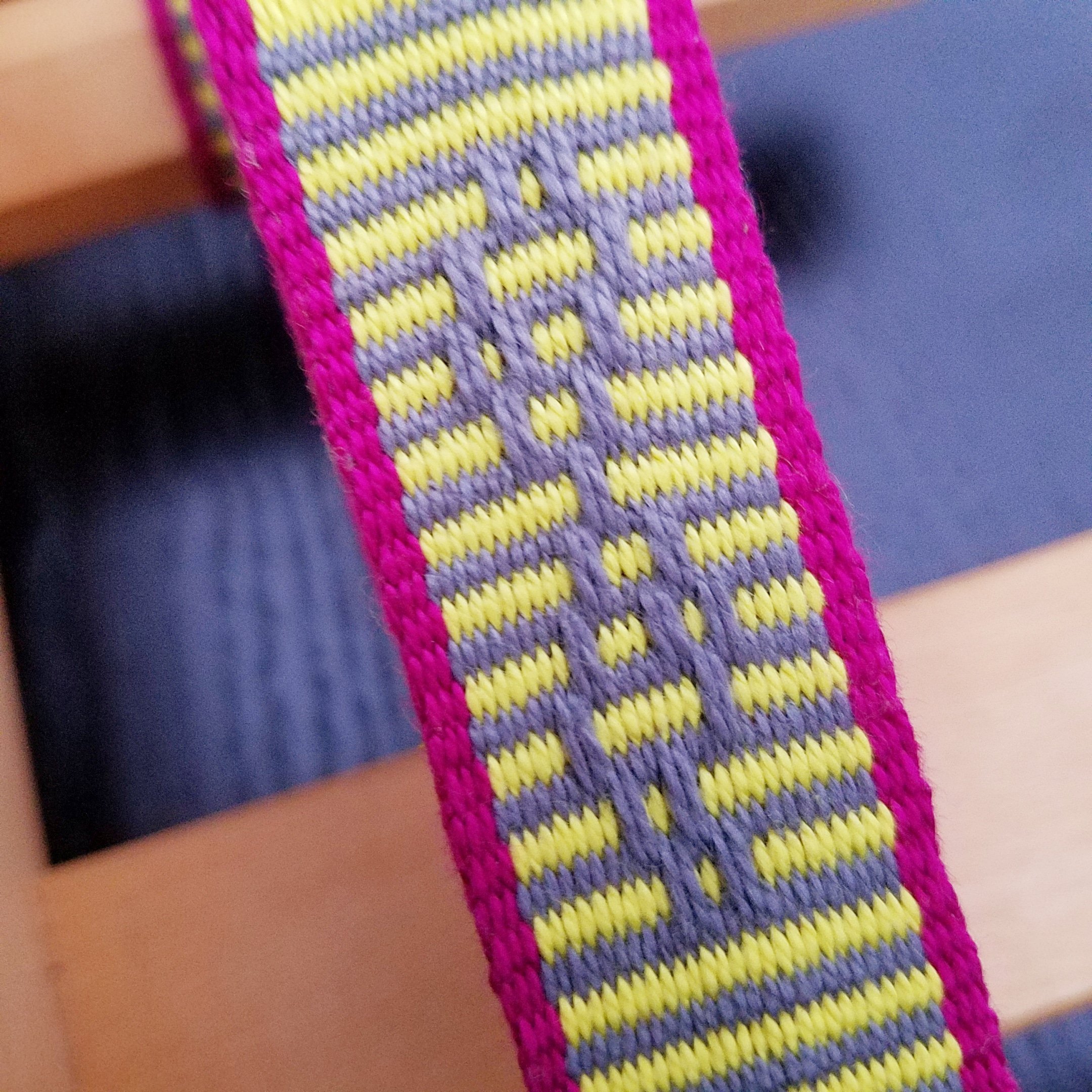
Welcome to February. I was not sure what colors to use for my band this month. For some weavers, choosing colors is easy peasy. Not so much for me. I suffer from the affliction of color indecision, too many choices and I struggle to settle on what is the “right” combo of colors. I mostly weave with Lunatic Fringe Yarns Tubular Spectrum yarns, 45 colors of cotton goodness, and oh my, talk about color choice! Some years back I wrote that their yarns is like having a 64 box of Crayola Crayons. I might start putting colors in a hat and just selecting at random.
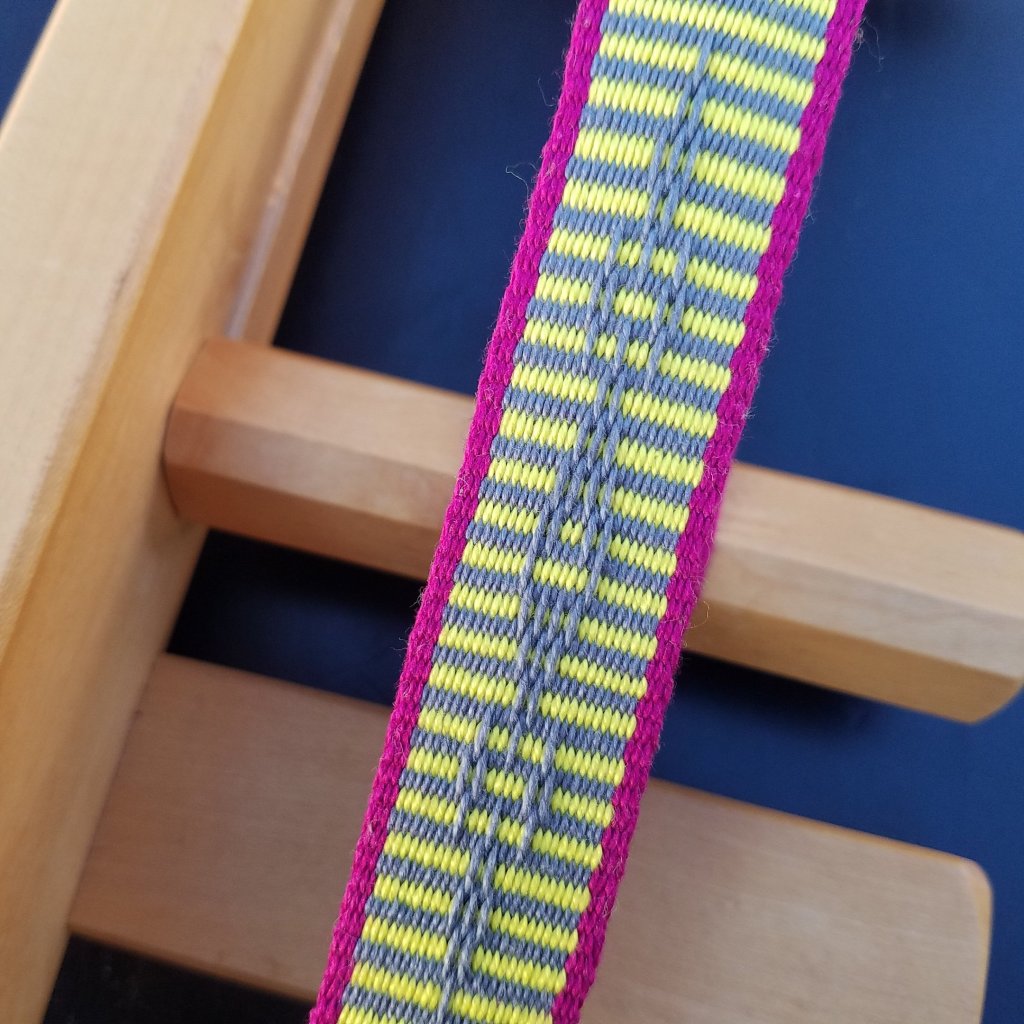
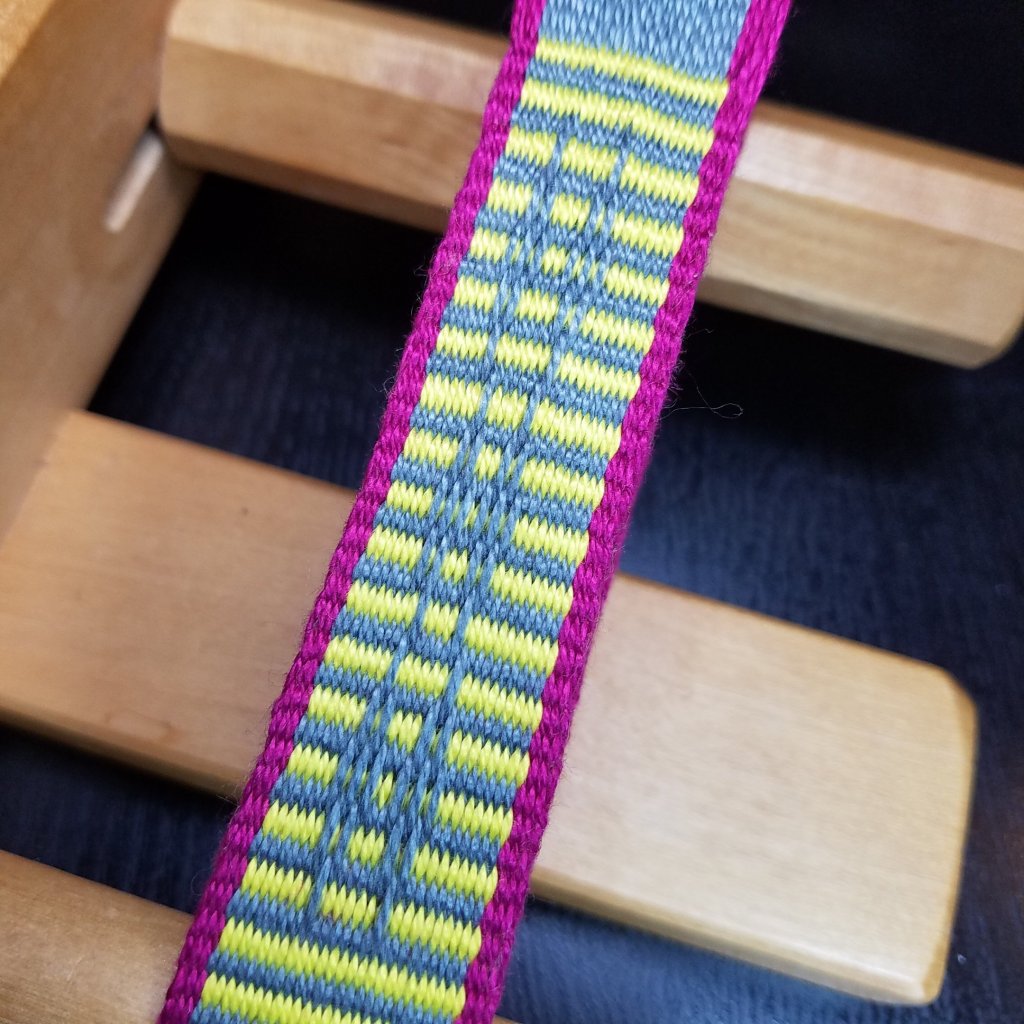
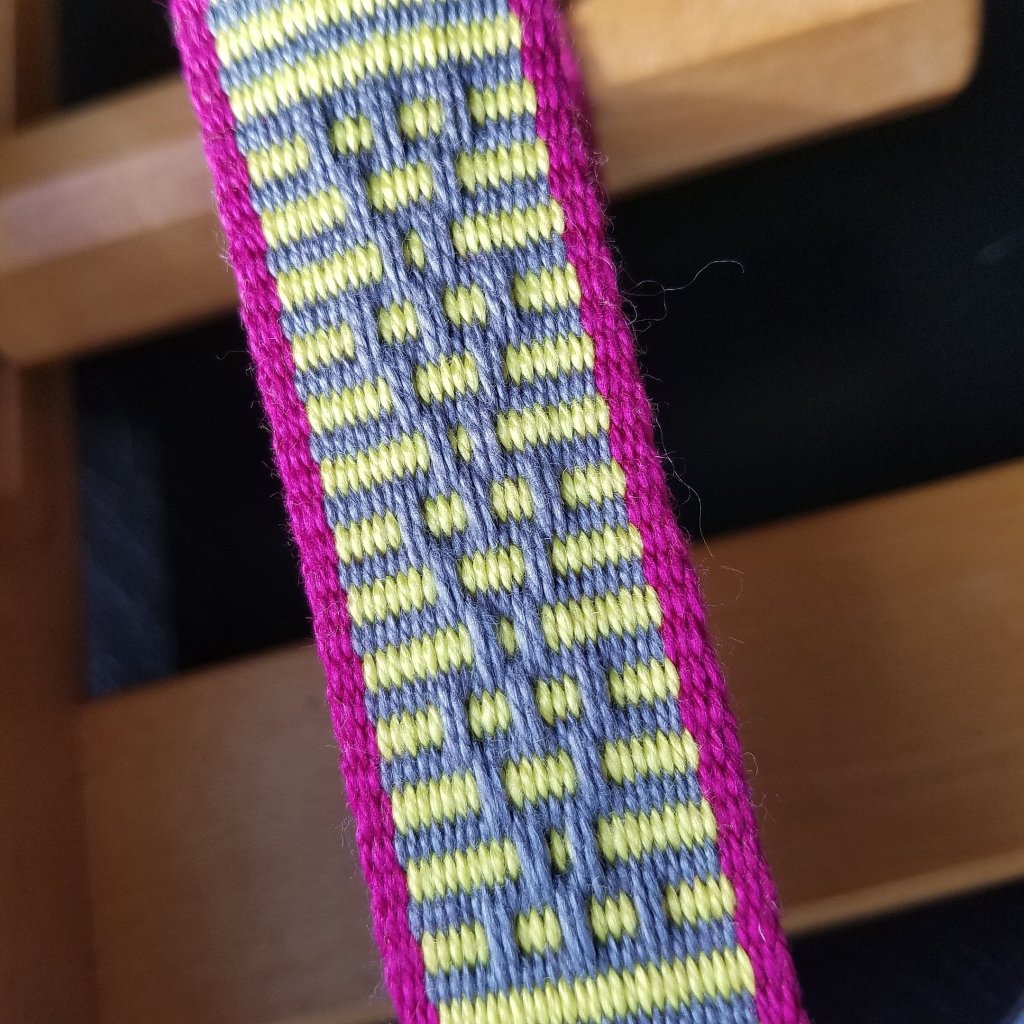
My inspiration for this month came from the Pantone Color of the Year 2021 colors, Ultimate Gray and Illuminating yellow.
Of course Lunatic Fringe had two colors that fit the bill perfectly, 10 Yellow and Dark Gray. For the borders, I chose 5 Red Purple as a nod to Valentine’s Day.
These colors are making me so happy! Thanks Pantone for the inspiration. What do you think? While I might have paired gray and yellow with black or white, you know, pretty, but safe combos, magenta is outside of my normal color aesthetic safety zone, for sure.
Total random thought, how do you spell gray? I have always spelled the word g-r-e-y and find it interesting that both Pantone and Lunatic Fringe Yarns spell it with an A. According to Merriam-Webster.com, “Gray and grey are both common spellings of the color between black and white. Gray is more frequent in American English, whereas grey is more common in British English.” I am originally from the Northeastern United States . . . Not sure why I spell it like the British.
All of the motifs here are from The Weaver’s Inkle Pattern Directory: 400 Warp-Faced Weaves by Anne Dixon, pages 34 & 35.
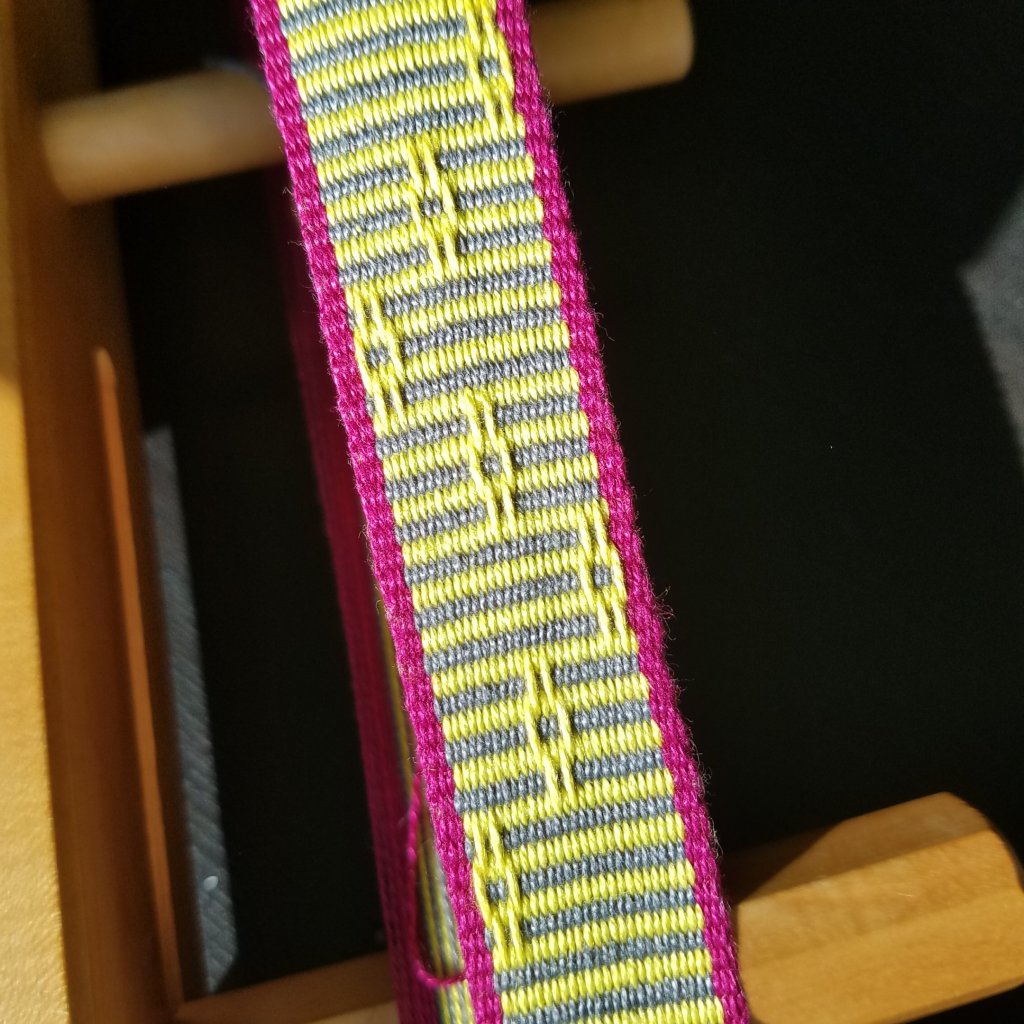
The last two days of January both had such a delicate lacy feel I thought I’d share them together.
Day 30
Day 31
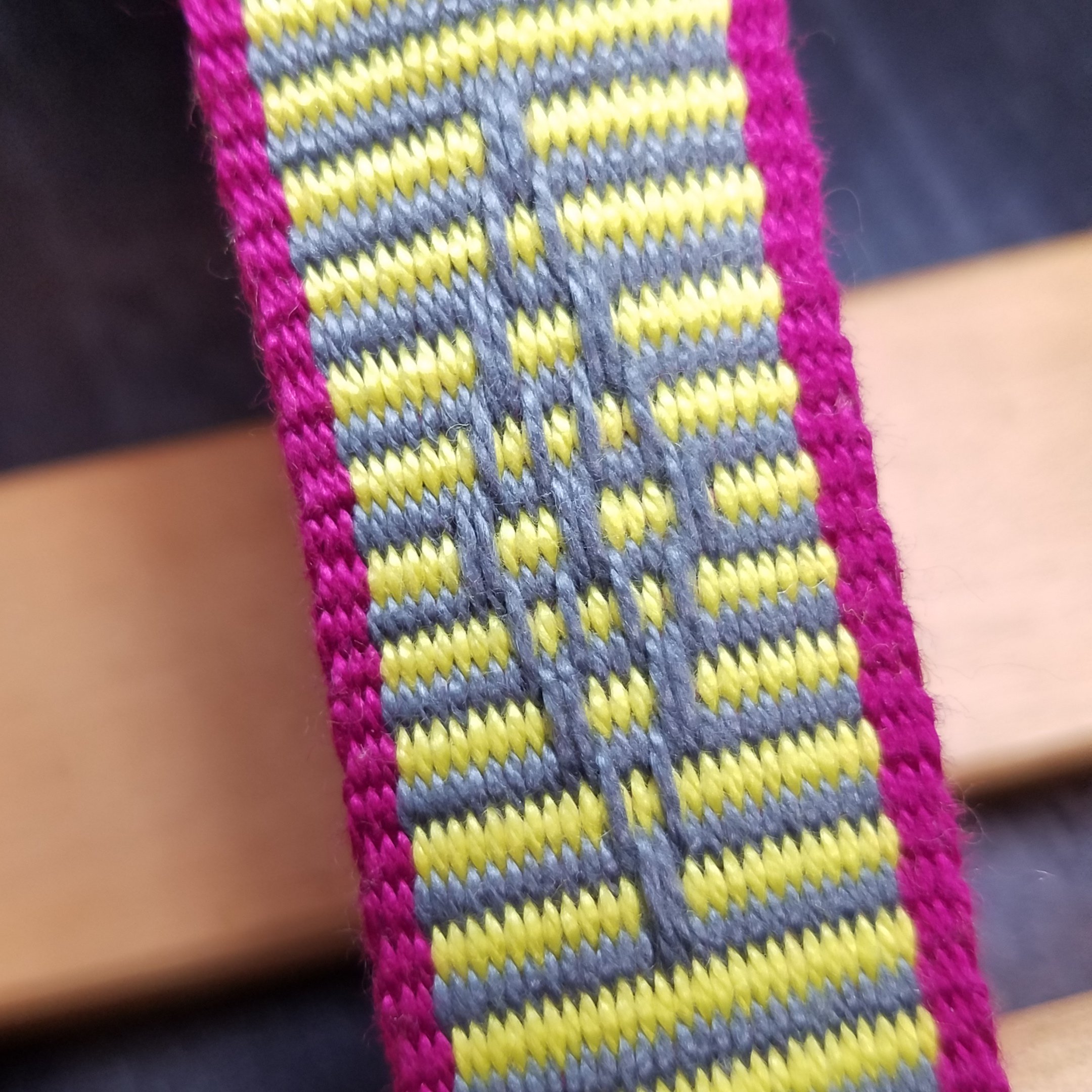
Most of my early bands were woven in 10/2 perle cotton. When I first started working with 5/2 it seemed so thick. It is now one of my favorite sizes to work with. Here it seems so light and airy. The alternating pick-up reminds me so much of lace.
I played weaving chicken with both of these motifs. They both filled the entire length of the weaving distance between the heddles and the front peg on my little travel inkle loom. I barely had enough room to fit the whole motif to be able to take a picture of it. While I was weaving it, I had to advance the motif past the front bar, finish the motif, then back the band up to the heddles to snap the picture.
Wow, my first month of daily band practice is done. It’s been amazing taking time, with intention, to weave every day, even a few inches. I thought ending the month with a flower was fitting; let it grow.
Both motifs are from Inkle Weaving by Helene Bress, page 124 (194a, e).
Every day I have been glad I chose to do a daily band practice this year, but I was especially so on this day. I wove, in spite of it being one of those days when you have a plan but the universe has a different plan. Nothing, awful, just one of those days. Only because I have committed to make time this year, instead of trying to find time for my passion, was I able to weave at all that day. It brought me the peace and calm I needed.
Oh, and is it just me of does this motif look like a robot? It didn’t resemble a robot in the book. . . This little robot, who aptly represents the energy I needed channel that day, comes from Inkle Weaving by Helene Bress, page 124 (194g).
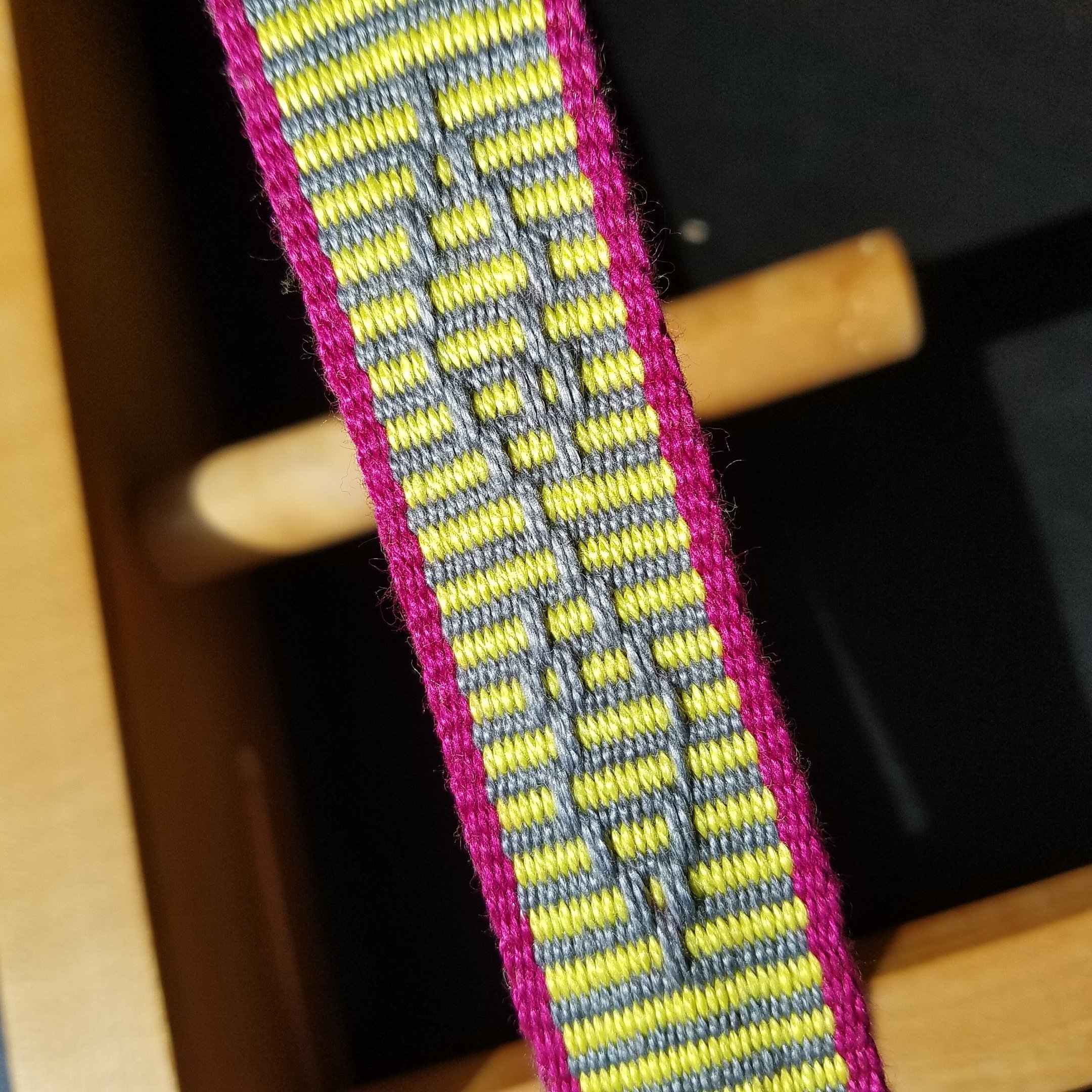
Is it strange that this pattern made me smile? This fun motif looks like two sassy X’s stacked on top of each other. When I told that to a friend she laughed and showed me a picture of her sassy little niece, proudly standing with a hand on her hip, the other raised in the air, and her foot kick out in ta-da pose. She was the personification of this sassy little X.
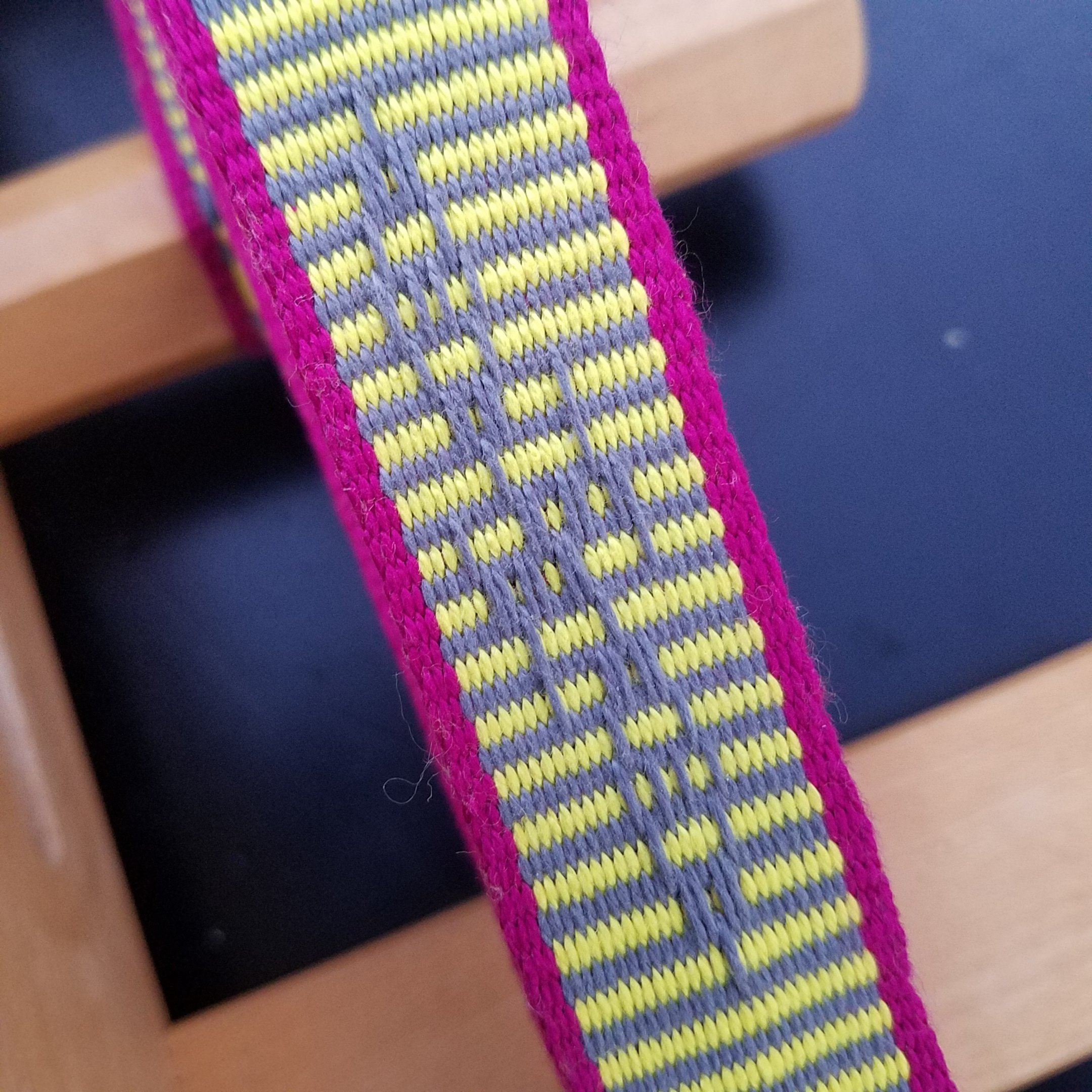
The motif has an interesting heavy and light feel. By mixing groups of three threads and single threads the pattern creates motion and depth. This could be useful in designing a more pictorial type of designs.
Day 27 comes from Inkle Weaving by Helene Bress, page 124 (194i). Until next time, go be sassy!















 inkled pink